
Redbeard
As the coasts are battered by heat waves and rising oceans, it’s a good time to live in the beautiful Mountain West. All the more so for fans of RSL, because the Sultans of Salt Lake (is that their nickname?) are at the top of my MLS Fan Value Index for the second time in three years.
Real Salt Lake has begun the 2026 season with a massive overall home field performance, earning 2.63 points per game before the World Cup break (tied for 2nd best in MLS), an improvement by 1.25 ppg over its 2025 start. That success has brought butts to the seats (six percent more than this point in 2025) and RSL’s front office continues to sell among the least expensive season tickets in Major League Soccer (and kept the same price as last year).
Sources and Methods
I retooled the formula for the 2025 version of this Index and have kept it unchanged for 2026, so this year’s Fan Value scores are directly comparable to last year’s. The data points for input are: Home points per game (3 points per win and 1 point for ties with a score -- draws that end 0-0 and losses both earn zero points), attendance at Home matches, the Home stadium’s capacity, and the price charged by the team for its cheapest season ticket.
Win/loss and Attendance numbers come from fbref.com. Stadium capacities are from a variety of sources (though I use the team’s official website when possible). And the hardest part of this data collection -- season ticket prices -- comes from a combination of official team websites, reliable-looking reports on fan websites and subreddits, and phone calls I had to make to several teams’ ticket offices. (Boooooo.) But, for the first time in three years of running this Index, I was eventually able to find pricing information for every team in the league!
As before, I attempted as fair of a comparison as I could. So, with ticket prices, for example, I used the advertised “sticker” price, when available. Some teams include taxes and added fees in that number while others don’t; I used the prominently advertised number. Similarly, I did not adjust for extra benefits that teams provide to season ticket holders -- like merchandise discounts, tickets to games outside the MLS regular season, or tickets to away matches -- because trying to assign consistent league-wide values to those would be madness.
I did continue to apply a weighted adjustment to stadium capacities to account for games played in other venues (like Colorado’s match at Mile High) and for NYCFC’s five games at Yankee Stadium vs. three games at Citi Field.
Attendance Slowly Climbing
When I last ran these numbers, shortly after the Leagues Cup break in 2025, teams had played most of their home games for the season (14 of 17) and league-wide attendance looked … not great -- down more than 5% from a similar point in 2024. Although we’re at an earlier point in the season (most teams have played only 7 home games so far), more fans are coming out and MLS stadiums are about 2% fuller. The average game in 2026 is attracting 22,087 people. (That’s still more than a thousand fewer than 2024 but the trend compared to 2025 is upward.) We’ll have to wait and see whether there is a post-World Cup bump.
In 2025, attendance was worst in Vancouver, where the Whitecaps barely managed to fill BC Place one-third full, a reduction of about 28% compared to 2024. That left plenty of room for more fans to fit in, which they now have. Although still far below 2024’s average of 27,696 per game, the Caps are averaging attendance of 24,189, which is about a 20% improvement year-over-year, the strongest growth in the league. It’s also back above the MLS average (22,087). DC United similarly has wiped away most of its double-digit attendance drop from last year with a 10% increase in 2026.
San Jose’s fans seem to believe there’s real change afoot. The Quakes were one of only two teams to grow attendance by more than 10% in 2025 and they are doing it again right now (+11.7%). In just two years, PayPal Park has gone from less than 75% full to more than 93%. This rate of increase obviously isn’t sustainable since they are now close to selling out, but the Index uses attendance on a percent-of-capacity basis, not raw numbers, so San Jose will continue to be rewarded even if it just maintains this level.
Note: The league-wide average does mask some exceptionally poor performers. Five teams are seeing attendance drops of 15% or more compared to 2025. They are Atlanta United (-15%), San Diego FC (-15%), CF Montreal (-16%), New England Revolution (-21%), and Chicago Fire (-22%). Chicago, at least, has a new stadium to look forward to (at a minimum, its smaller size will help the Fire on a percent-of-capacity basis); maybe the rest should follow suit?
Costs Go Up, But Still Not Everywhere
For season ticket membership (STM) price comparison, I look at the cheapest package that will get a fan in the door for all 17 regular season home games. (Usually this is in the team’s supporters’ section.) If you want extra amenities like food and drinks, or even an actual seat, then research and compare those prices yourself -- that’s beyond the scope of this Index. When I talk about prices, it is each team’s cheapest season ticket package, as sold by the team.
In 2026, teams broadly fell into four pricing groups: price decreases, no change, price increases, and … San Diego.
Six teams lowered their price from 2025, led by Seattle Sounders which began offering a new “GA Membership” ticket that is 43% cheaper than its cheapest 2025 ticket! This discounted STM comes with limitations (including that tickets can’t be resold or transferred) but it meets my criteria and will get a fan who wants to attend every home match into the stadium. Atlanta also lowered its price this way (-11%) with the new “Canopy Pass” limited ticket.
Seven teams left 2026 pricing unchanged, including the top Fan Value team, Real Salt Lake. (I include NY Red Bulls in this “no increase” group, its price went up by just $2.) Charlotte FC didn’t change prices and just announced it is ending its experiment with Permanent Seat Licenses (the not-very-tasty PSL) after multiple seasons of declining attendance and never having a season where Bank of America Stadium was more than half-full. An eighth team, Austin FC, increased its price by 2.5%, which was less than Consumer Price Index grew over the same time period, which means the price did not increase when adjusted for inflation.
Twelve MLS teams increased their ticket prices by more than inflation would explain, ranging from Orlando SC (6%) to NYCFC (15%). Shield winners Philadelphia Union chose a 6.6% increase. Vancouver increased its prices from 400 Canadian Dollars to 425 CAD, a nominal rise of 6.25%, but for purposes of fair comparisons within this Index, I convert the three Canadian teams’ prices to US dollars using the exchange rate as of January 1st. That rate is higher this year than in 2025, so Vancouver’s effective price increase is 11.4%. Four teams are guilty of raising prices by more than 10% in both 2025 and 2026: Columbus Crew, FC Cincinnati, Nashville SC, and Vancouver Whitecaps. Columbus now has the 4th most expensive ticket in MLS (up from 12th place just two years ago).
San Diego is in a class of its own with a 101% price increase over last year -- more than double. This is explained by low promotional pricing for its inaugural 2025 season but also explains why the Chrome Wheelies (I really should learn more team nicknames) have shed attendance by 15% and have the second-highest ticket prices in the league with just a two-thirds full stadium. 1.33 points per game at home (bottom third in MLS) will not cut it at the prices San Diego is charging its loyal fans. (Miami and LAFC rank #1 and #3, respectively, among MLS season ticket prices in 2026, but I wasn’t able to get data for their prices in 2025, so I’m not able to report their year-on-year change.)
Fan Value Top Five
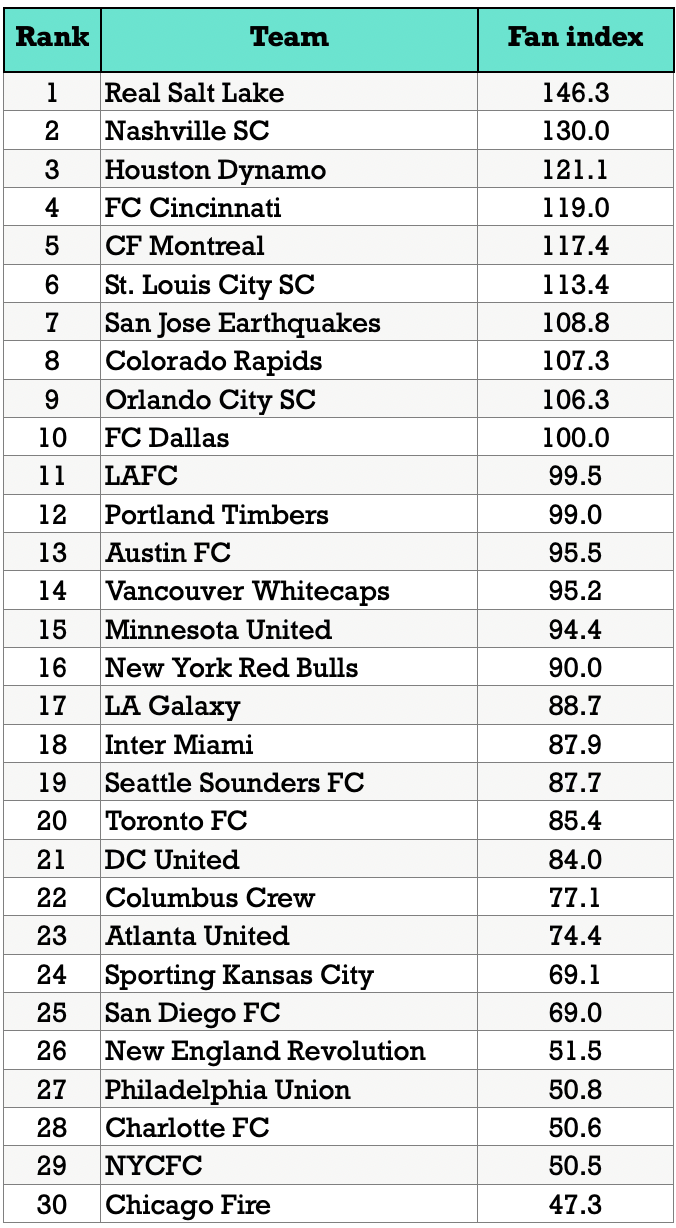
In first place, again, is Real Salt Lake (145.3 points). Last year, RSL was a respectable 5th in the Fan Value Index, with middling home wins, barely top-third in attendance-by-capacity, and a very-helpful 4th cheapest season ticket. In 2026, across every metric valued by this Index, RSL has improved to be near the top of the league -- tied for 2nd in adjusted points per home game (2.63), 8th best in attendance percentage (96.5%), and still the 4th cheapest season ticket (two-thirds the price of the league average). This Index intends to measure how well each MLS team is providing real value for its fans’ dollars and the Sandy Sovereigns (that can’t be right) are hitting a home run.
In second place is Nashville SC (130 points). Last year’s top team didn’t fall, it was leapfrogged. The Six Strings (AI says this is a common nickname; all the kids are using it) improved on their own 2025 score by 9 points thanks to even more home points per game and higher attendance. NSC’s $450 season ticket in 2026 is 15% more expensive than 2025 and 31% more than 2024, but still below the league average and fans are getting a good show for their money.
In third place is a new entrant to the Top Five, Houston Dynamo (121.1 points). Leaving ticket prices at 2025 levels (5th cheapest in MLS), combined with an 8% increase in attendance and a significant improvement on the field (moving from 6th worst team in 2025 to 6th best in 2026) allowed The Orange Crush (I found that one on Wikipedia) to demonstrate its best fan value since this Index began. (And an index score higher than last year’s winner. This is a competitive season for providing value!)
In fourth place is FC Cincinnati (119 points). Last year’s second-place team (in both the Index and the Shield) is showing a slightly better home record and a 3.8% increase in attendance, but The FC has also increased ticket prices by 28% since 2024 (and 52% since 2021, the first season in its current stadium). Since the Garys are close to sellout attendance, I expect them to continue slowly falling down in Index rankings unless the on-field performance significantly improves or price hikes ease.
Next I have to deliver my annual reminder that the Fan Value Index tracks several metrics and successful teams don’t have to excel in all of them. For example, a team that isn’t having the best season on the field can still rank highly on the index by offering good prices for tickets and drawing fans into the stadium -- value is about being entertained for a fair and reasonable price. Winning helps, but it isn’t everything.
So, in fifth place … CF Montreal (117.4 points). After finishing the 2025 season, embarrassingly one rank above the Wooden Spoon, Montreal’s front office has clearly entered “do something” mode -- and they have. The Poutines (okay, that’s the last time I ask AI for help) slashed season ticket prices (-26.5%) and have improved on the field (tied for 12th in adjusted points per home game). We’ll have to see whether these moves are enough to bring soured fans back -- attendance at Stade Saputo is down (-16%) and it was already one of the smallest venues in MLS. CFM’s 13,821 average attendance so far is easily the lowest in the league if you ignore FC Dallas (which I do for this, because FCD is filling all 11,004 seats that are available while its stadium undergoes a multi-year reconstruction). Montreal has 11 more home games to show that its position in this Index is well earned, not a fluke.
Needs Improvement
Three teams deserve dishonorable mentions, having landed among the Bottom Five of the Fan Value Index in all three years: New England Revolution, Charlotte FC, and Chicago Fire. These teams have been consistently unable to provide fans good value for soccer in their giant NFL-size stadiums. (And it’s not just the stadiums -- Seattle ranks 19th this year and Atlanta has never been in the Bottom Five.) Do better!
The 2026 Index
The full Index with supporting data is available on this Google Sheet.